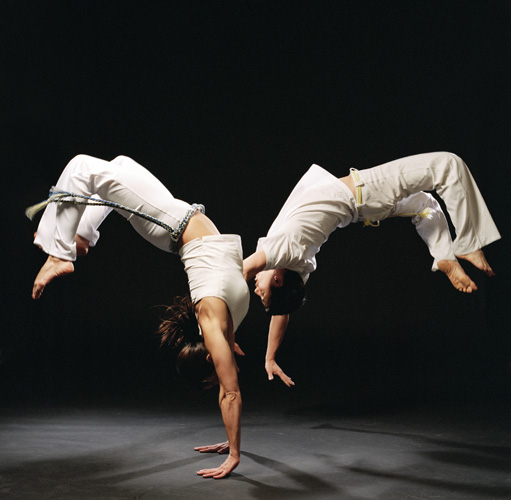
The Feminine in Capoeira, Part 2 (Context)

14 12 2007

Within or without capoeira, it's all about context. 

What’s wrong with being “feminine”?  That was the question nagging me as I finished Part 1 (Malicia) of this topic.  As pre-empted by some of the comments that followed, I also started having doubts in terms of the need to place capoeira and capoeira discourse in the context of its cultural origins.  Additionally, one of the things I’m starting to fear doing on this blog is going too deeply into text and discourse while I write, too far into another plane, and forgetting that it’s all supposed to come back down to be grounded in good ol’ everyday capoeira.  (On the other hand, sometimes that’s the fun part…)


Sorry for the extra bit of waiting this time this round!  I did a lot of thinking for this, so I hope it’ll have been worth it…  Today, I’ll start by excerpting from an article on www.capoeira.com, in which Jessica Fredican responds to sexism in her capoeira class and Nestor Capoeira’s take on malicia:

He talks a lot about malicia and, at the time, I was really turned off by it. … But the nicest games still involve being able to outwit and trick your opponent….

These goals lend themselves perfectly to traditional views of feminism. Ancient cultures worldwide have invented stories and myths that portray women as internal, sinuous, ambiguous, dangerous creatures. They aren’t external like men, carrying their genitals outside their bodies, displaying great feats of strength. Yet, women have this dangerously inexplicable power to knock men on their asses. This primordial and universal femininity involves hiding your intentions and using unexpected and unseen manoeuvres to defeat the opposite sex.

So maybe we should just be feminine. It would almost seem that capoeira was designed especially for women – a circle (a traditionally feminine symbol) in which to carry out their dangerous rituals of masking and trickery.

This was the article that started my doubts.  I loved the ideas in it, and the way she framed universal stereotypes of “the feminine” made me think, “Well, what’s wrong with that?”  Personally, I think it’d be pretty cool to have a “dangerously inexplicable power to knock men on their asses”, so if that’s what it means to be “feminine”, then why not “just be feminine”?  Same with the other things she said–if being “feminine” means being able to “hide your intentions” and “use the unexpected”–in other words, if being “feminine” means being an expert in malicia–well, wouldn’t it then be a compliment to be given that label, rather than anything derogatory? 

And especially that last part–if capoeira itself not only consists of the feminine but is the feminine–then, how in the world could it be a bad thing?

I believe all of this relates to context.  In the philosophical, metaphysical, symbolic context of capoeira, “the feminine” is esteemed because it is the source of malicia, and malicia is esteemed by capoeiristas.  I think where we run into trouble is when such symbolism is taken out of context–out of the centuries of culture and history and mythology that Nestor Capoeira and Muniz Sodré were drawing on when they characterized malicia–and then applied to everyday life, whether unthinkingly or not. 

[Side note: While I’m exonerating Nestor Capoeira and Muniz Sodré from the accusation of sexist views, on grounds of cultural context, I also want to add that in hindsight, their use of the word “power” could have meant brute force rather than power in the more general sense of the word, especially since I’m sure many consider malicia to be a power in itself.]  

For instance (returning to what I was talking about before the side note), in the symbolic context of capoeira, “the feminine” is partially defined as “not rational”–by which it is meant that you can’t explain malicia, you can’t use reasoning and logic to teach it to a student, the same way you can teach them how to land a kick properly or where to place your hands while doing rolé.  Switch into the everyday context of running a business though, or governing the country, and this “symbolism” is exactly why we have things like the glass ceiling, and why while 52% of the Canadian population is female, they are represented by a government that is nearly 80% male.

Now, I am not saying I think that people begin learning capoeira, get introduced to malicia, and start subconsciously discriminating against women (give me more credit than that!).  However, it is something similar that occurs, in a larger pattern over time and throughout society; only, instead of capoeira and malicia, people learn it through myths, through religion, through normative fairy tales and children’s games.  The specific mediums and symbols differ, but they all send the same messages about women and what “feminine” and “female” mean, without any barrier of “culture and history” to contain them in their respective contexts, as we do with capoeira. 

So I suppose that’s really what I wanted to get across in Part 1.  My conclusion is that though I still don’t like what Muniz Sodré said, I can understand that it does add depth and interest to thinking about capoeira and the game, and that it’s okay as long as we keep it within the metaphysical/philosophical/symbolic context of capoeira, that it’s actually more than okay because this way we preserve part of the roots of capoeira, and the culture and traditions it was steeped in.  It only becomes not okay when we take that message out of context and apply it to the “real world”, which is what you see happening in the media, workplace, government, etc., today, and even to the everyday world of capoeira, which is why I had to write this post.  Thanks again to everyone who commented last time, and as always, muito axé. =)

Picture source:
http://capoeira.uchicago.edu/Gallery/Kristie/studio/back_handspring.jpg

————————————————————————————
If you found this post useful or interesting, please
click to subscribe to my blog, by RSS feed or email!
————————————————————————————


The Feminine in Capoeira, Part 1 (Malicia)

12 12 2007

Malicia - the feminine in capoeira?

In my very first post, I mentioned that capoeira seemed to be an art form mostly dominated by men; in fact, it’s one of the main reasons this blog exists in the first place.  What’s interesting is that while some of capoeira may be male-dominated, it is not traditionally masculine, the way people might consider football or rugby to be.  Several fundamental aspects of capoeira have been characterized as belonging to the feminine, in ways I find in equal parts inspiring, thought-provoking, and problematic.

I first encountered this in Nestor Capoeira’s book, Capoeira: Roots of the Dance-Fight-Game, in which he deems malicia a manisfestation of the feminine in capoeira.  Unfortunately, I’m living away from home right now and thoughtlessly left the book there, so I can’t quote his exact words to you…but his thoughts were reiterated later on in the book by scholar Muniz Sodré, and due to a brilliant stroke of luck, this particular passage was reproduced in Google’s Book Search Preview:

You also say that malicia belongs to the Feminine aspect of things. I like that. While Masculine is the gender of the defined, the understandable, rational—the gender of power—the Feminine is, on the other hand, the reverse of all this. It is the void. Its power is also of the sort that you don’t know exactly what it is. Its power is “not to be clear” about power itself. It’s the power of the void. Because malicia is exactly that: to go around what is clear and established. And in that sense it is Feminine.  (Sodré as quoted by Capoeira, p. 30)

You can see for yourself (I hope) why statements like that are problematic.  The “void”?  The reverse of “rational”, of “power”?  This is where things get tricky.  As a capoeirista and English lit major, I can appreciate the symbolism in that, the evoked nature of malicia and the dimension it adds to capoeira and the jogo.  And as a feminist, I feel (with all due respect to Nestor Capoeira and Muniz Sodré) that that can’t be right, there must be another way to put it, and that the whole thing should be torn up and sent back into the 19th century, where that kind of thinking belongs!  How exactly do I go about doing this while maintaining the integrity of both capoeira and modern-day/feminist thinking?

The main issue here, I think, is the seemingly necessary genderizing of things, when in fact it’s not necessary at all (let alone the use of capital letters, which just makes the terms look way more qualified than they should).  It’s cool to think of malicia as the “power of the void”, as that unexplainable, irrational thing that gets in through the cracks and hits you where you thought there was nowhere to hit.  When you say that malicia is all these things though–void, irrational, unclear, evanescent–and therefore feminine, that’s where you lose me.  “Void” is exactly what we are not supposed to be! And you can say that assigning feminine and masculine aspects to capoeira adds meaning and depth, similarly to nuance and capoeira movements in the roda, but I think there is a way around that.

The whole reason it’s appealing to associate malicia with the feminine is because of all the things that have been associated with the feminine throughout history.  When you say malicia is “feminine”, you are really saying malicia is mysterious, elusive, intangible, and all those other things that Nestor Capoeira and Muniz Sodré said, thanks to stereotypes that have been entrenched probably since humans first learned to discriminate.  I believe it’s possible to “de-genderize” concepts like malicia while retaining the things one actually means when labelling them “feminine” or “masculine”.  Referring again to the nuance in movements analogy, we do not say that a chapa is “masculine” because it’s aggressive, or that a bait-and-switch sequence is “feminine” because it’s deceptive (or “went around what was clear”)–they are just aggressive and deceptive, respectively.  So why can’t malicia just be what it is, without perpetuating outdated stereotypes at the expense of women and the feminist movement today?


Update:
To read Part 2 (Context), please click here.


Picture source: http://www.baurock.ru/kostik/capoeira.htm


A martelo / By any other name would hit as fast: Nuance in the Capoeira Game

10 12 2007

What message are you sending with your kicks in the roda?One of the first things I remember learning vividly in capoeira is the concept of nuance (so this first bit will pretty much all be taken from my teachers’ mouths).  Every kick, every move you do has a certain meaning.  When you enter the roda, you enter a foreign world–and so you better know the language.  Questions are posed by your body, not your mouth; smalltalk is delivered with armada, esquiva, quexada; and silent screaming matches are played out in the form of chapa, tesouro, martelo, and the like.  Don’t give a certain kick or do a certain move if you’re not prepared for the consequences, because you never know how the other person will react to the provocation. 

This all makes sense, and it’s beautiful to think of every movement in the roda as meaningful as words, the game a dialogue with as much potential and as many implications as a scene from Hamlet.  However, recently I’ve been thinking about something new: what if there were no nuance? 

My initial reaction was: “Well, that would be weird.  Then people could do anything.”  Then: “Wait a minute…people could do anything.”  Think about it!  Let’s say you’ve just been working really hard on something–a new rasteira set-up, for example–and wanted to try it out in the roda (because we all know that executing a move in class is nothing like trying to execute it in a real game).  How are you going to do that?  You don’t want to go after someone who has a lower belt than you, and if you try it on anyone else they might become mad and get aggressive on you, which you’re not really looking for at the time.  Of course, this is not always necessarily the case, but “better safe than sorry” if you’re paranoid like I am about these things.  If moves had no nuance and everything was fair game, you could go in and test yourself without worrying about inadvertently offending the other person (unless you did a particularly poor rasteira and rammed your foot into their ankle, or something). 

But that’s only a tiny part of it; let’s look at how having no nuances would impact the game overall.  Well, for one thing, no one would have to hold back!  You could do anything without worrying about unduly offending the other person, within reason (i.e. you’d still have to use legitimate capoeira moves…and we’ll leave “But what is legitimate?” for another time).  Which, in a way, makes sense…because if you think about it, anything you do could be considered just part of the game, part of capoeira.  The very unexpectedness of a sudden chapa de costa could be considered just a part of what capoeira is, and the other person shouldn’t get mad because 1) being a capoeirista, you could say s/he should know to expect the unexpected and 2) to reiterate, it’d all just be part of the capoeira game. 

[Now watch me get killed by a sudden chapa de costa the next time I train at my academy XD]

And what games, if people didn’t hold back!  You could put the heat on and play aggressive but in a fun and challenging way for both players, without the game becoming negative.  Instead of smalltalk versus argument, you now just have constant banter, all the way through.  (From Hamlet to Much Ado About Nothing, you might say =P)

Of course, people do all of this on their own anyway, without necessarily having an academy-wide “anything goes” philosophy.  And teaching that every kick has a difference nuance is good for protecting beginners from getting accidentally harmed in the roda, and for making sure they really know something before trying it out on a more experienced player without thinking.

Also, by “anything goes” and lack of nuance, I don’t mean that you can do anything and get away with it, without any consequences–not at all!  The other person can still retaliate, at any time, and they have the right to.  The difference is that they won’t suddenly lose their temper on you, they won’t take offense and hold it against you, and you’ll both know that whatever happens, it’s nothing personal, just all part of capoeira and the game, and both players would probably be the better for it.

Personally, I’m actually fine with nuance, since I was trained in it, and like I mentioned, the drawing of parallels between capoeira and words and language really appeals to me.  However, it might be something worth thinking about, for the next time you enter the roda!


Why Write about Female Mestres? The Feminist Catch-22

5 12 2007

Catch-22 (noun): a no-win situation

If you read the “Update” section on Mestra Edna‘s profile (previously the first half of this post, but I moved those paragraphs for clarity’s sake), they lead up to the main dilemma I encountered while writing about her: Why?  That is, why should Edna Lima be singled out and featured, among all the other mestres comparable to her and who might have accomplished just as much or more?  According to my own blog, it’s because she’s not just a mestre, but a female mestre.  But isn’t writing about her just because she’s a woman just as tunnel-visioned as ignoring her just because she’s a woman?  Aside from the slightly more justified qualification that Edna Lima is not only a mestra, but the world’s first (a reason that won’t apply to the other mestras and mestrandas I intend to write about), I think my response to that would be yes, to a certain extent, but it’s tricky because right now, the world seems to be stuck precariously in a stage between stasis and regression, feminism-wise. 

We are not so advanced that women are free from discrimination and harassment in business and the workplace, in politics and the government, in entertainment, in the media, in advertising, and in many cases everyday life; yet, we have progressed just enough since the days of the suffragettes for many people to believe that more talk of women’s equality is completely superfluous.  That’s the catch-22: if women really were equal, we wouldn’t have to keep stressing “a woman did this!  a woman did that!”  The actual stressing itself emphasizes the divide.  Yet if we don’t say anything, the divide still remains, and becomes ever more entrenched.  People know, for instance, that women can be CEO’s, doctors, and engineers—but they don’t know that on average, they’d have much lower salaries than male counterparts doing the exact same job, with the same qualifications and experience.  (Apparently, the same goes for short people and tall people, which absolutely sucks because I’m female and short.)  Then there was an article I read about how even though women can run for government, it’s much harder to and they are asked less to than men are, so the overall atmosphere itself still provides an obstacle to a level playing field.  Finally, look up anti-Hillary Clinton groups on facebook, then read this from Antigone Magazine.

Returning to Mestra Edna and the all the rest, I’m not saying that there’s some sort of hidden sexism in capoeira, and I’m happy to say I’ve never encountered anything even near it myself during the whole time I’ve been doing capoeira (although I’ve heard it said, for example, that a teacher would have long been graduated up a level by now if she were a guy).  On the other hand, one can’t really deny the nature of Brazilian culture that of course pervades capoeira, and when Mestra Edna mentioned in an interview that “music is one area in which women…still take part significantly less than men”, it did occur to me that I’ve only ever seen one woman play in or even practice for my group’s performance band, and I haven’t seen that many women play the berimbau during “official” (as opposed to just in-class, for-practice) rodas, either.  Granted, it’s fair enough to say that’s only due to lack of personal initiative on their parts and nothing else, but looking at the big picture, it might still be something worth noting. 

So I guess the conclusion I’ve drawn, then, is that while at times it might seem like making mountains of molehills, or purposely trying to draw things out of thin air, the overall state of things still seems to require that attention be brought to certain issues, lest people settle into casual apathy and slip obliviously into the state of regression mentioned above.  It shouldn’t be that capoeira mestres are spotlighted specifically for their gender, but until society collectively achieves a mentality where gender truly doesn’t matter (aside from the obvious, e.g. repopulating the human species–which itself might be a dubious goal to a lot of people), this seems like the best we can do.