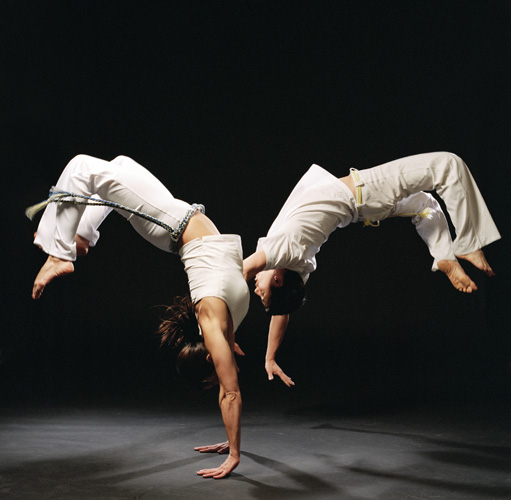
The Feminine in Capoeira, Part 2 (Context)

14 12 2007

Within or without capoeira, it's all about context. 

What’s wrong with being “feminine”?  That was the question nagging me as I finished Part 1 (Malicia) of this topic.  As pre-empted by some of the comments that followed, I also started having doubts in terms of the need to place capoeira and capoeira discourse in the context of its cultural origins.  Additionally, one of the things I’m starting to fear doing on this blog is going too deeply into text and discourse while I write, too far into another plane, and forgetting that it’s all supposed to come back down to be grounded in good ol’ everyday capoeira.  (On the other hand, sometimes that’s the fun part…)


Sorry for the extra bit of waiting this time this round!  I did a lot of thinking for this, so I hope it’ll have been worth it…  Today, I’ll start by excerpting from an article on www.capoeira.com, in which Jessica Fredican responds to sexism in her capoeira class and Nestor Capoeira’s take on malicia:

He talks a lot about malicia and, at the time, I was really turned off by it. … But the nicest games still involve being able to outwit and trick your opponent….

These goals lend themselves perfectly to traditional views of feminism. Ancient cultures worldwide have invented stories and myths that portray women as internal, sinuous, ambiguous, dangerous creatures. They aren’t external like men, carrying their genitals outside their bodies, displaying great feats of strength. Yet, women have this dangerously inexplicable power to knock men on their asses. This primordial and universal femininity involves hiding your intentions and using unexpected and unseen manoeuvres to defeat the opposite sex.

So maybe we should just be feminine. It would almost seem that capoeira was designed especially for women – a circle (a traditionally feminine symbol) in which to carry out their dangerous rituals of masking and trickery.

This was the article that started my doubts.  I loved the ideas in it, and the way she framed universal stereotypes of “the feminine” made me think, “Well, what’s wrong with that?”  Personally, I think it’d be pretty cool to have a “dangerously inexplicable power to knock men on their asses”, so if that’s what it means to be “feminine”, then why not “just be feminine”?  Same with the other things she said–if being “feminine” means being able to “hide your intentions” and “use the unexpected”–in other words, if being “feminine” means being an expert in malicia–well, wouldn’t it then be a compliment to be given that label, rather than anything derogatory? 

And especially that last part–if capoeira itself not only consists of the feminine but is the feminine–then, how in the world could it be a bad thing?

I believe all of this relates to context.  In the philosophical, metaphysical, symbolic context of capoeira, “the feminine” is esteemed because it is the source of malicia, and malicia is esteemed by capoeiristas.  I think where we run into trouble is when such symbolism is taken out of context–out of the centuries of culture and history and mythology that Nestor Capoeira and Muniz Sodré were drawing on when they characterized malicia–and then applied to everyday life, whether unthinkingly or not. 

[Side note: While I’m exonerating Nestor Capoeira and Muniz Sodré from the accusation of sexist views, on grounds of cultural context, I also want to add that in hindsight, their use of the word “power” could have meant brute force rather than power in the more general sense of the word, especially since I’m sure many consider malicia to be a power in itself.]  

For instance (returning to what I was talking about before the side note), in the symbolic context of capoeira, “the feminine” is partially defined as “not rational”–by which it is meant that you can’t explain malicia, you can’t use reasoning and logic to teach it to a student, the same way you can teach them how to land a kick properly or where to place your hands while doing rolé.  Switch into the everyday context of running a business though, or governing the country, and this “symbolism” is exactly why we have things like the glass ceiling, and why while 52% of the Canadian population is female, they are represented by a government that is nearly 80% male.

Now, I am not saying I think that people begin learning capoeira, get introduced to malicia, and start subconsciously discriminating against women (give me more credit than that!).  However, it is something similar that occurs, in a larger pattern over time and throughout society; only, instead of capoeira and malicia, people learn it through myths, through religion, through normative fairy tales and children’s games.  The specific mediums and symbols differ, but they all send the same messages about women and what “feminine” and “female” mean, without any barrier of “culture and history” to contain them in their respective contexts, as we do with capoeira. 

So I suppose that’s really what I wanted to get across in Part 1.  My conclusion is that though I still don’t like what Muniz Sodré said, I can understand that it does add depth and interest to thinking about capoeira and the game, and that it’s okay as long as we keep it within the metaphysical/philosophical/symbolic context of capoeira, that it’s actually more than okay because this way we preserve part of the roots of capoeira, and the culture and traditions it was steeped in.  It only becomes not okay when we take that message out of context and apply it to the “real world”, which is what you see happening in the media, workplace, government, etc., today, and even to the everyday world of capoeira, which is why I had to write this post.  Thanks again to everyone who commented last time, and as always, muito axé. =)

Picture source:
http://capoeira.uchicago.edu/Gallery/Kristie/studio/back_handspring.jpg

————————————————————————————
If you found this post useful or interesting, please
click to subscribe to my blog, by RSS feed or email!
————————————————————————————


Video: The Movement of Capoeira

12 12 2007

I don’t know about you, but my head still hurts a little from working through yesterday’s post (and subsequent comments)!  While I take some time to clear up, straighten out, and hammer down the finer points of Part 2 (and oh yeah, study for final exams), I’d like to share a really cool video with you.  It’s a tribute to Grande Mestre No from Salvador, and some parts are a bit slow, but I like it because it seems to highlight the pure motion of capoeira, stripping it down to the essence of movement of the body, with beautiful results.  And thanks again to Xixarro for the tip on embedding videos!


The Feminine in Capoeira, Part 1 (Malicia)

12 12 2007

Malicia - the feminine in capoeira?

In my very first post, I mentioned that capoeira seemed to be an art form mostly dominated by men; in fact, it’s one of the main reasons this blog exists in the first place.  What’s interesting is that while some of capoeira may be male-dominated, it is not traditionally masculine, the way people might consider football or rugby to be.  Several fundamental aspects of capoeira have been characterized as belonging to the feminine, in ways I find in equal parts inspiring, thought-provoking, and problematic.

I first encountered this in Nestor Capoeira’s book, Capoeira: Roots of the Dance-Fight-Game, in which he deems malicia a manisfestation of the feminine in capoeira.  Unfortunately, I’m living away from home right now and thoughtlessly left the book there, so I can’t quote his exact words to you…but his thoughts were reiterated later on in the book by scholar Muniz Sodré, and due to a brilliant stroke of luck, this particular passage was reproduced in Google’s Book Search Preview:

You also say that malicia belongs to the Feminine aspect of things. I like that. While Masculine is the gender of the defined, the understandable, rational—the gender of power—the Feminine is, on the other hand, the reverse of all this. It is the void. Its power is also of the sort that you don’t know exactly what it is. Its power is “not to be clear” about power itself. It’s the power of the void. Because malicia is exactly that: to go around what is clear and established. And in that sense it is Feminine.  (Sodré as quoted by Capoeira, p. 30)

You can see for yourself (I hope) why statements like that are problematic.  The “void”?  The reverse of “rational”, of “power”?  This is where things get tricky.  As a capoeirista and English lit major, I can appreciate the symbolism in that, the evoked nature of malicia and the dimension it adds to capoeira and the jogo.  And as a feminist, I feel (with all due respect to Nestor Capoeira and Muniz Sodré) that that can’t be right, there must be another way to put it, and that the whole thing should be torn up and sent back into the 19th century, where that kind of thinking belongs!  How exactly do I go about doing this while maintaining the integrity of both capoeira and modern-day/feminist thinking?

The main issue here, I think, is the seemingly necessary genderizing of things, when in fact it’s not necessary at all (let alone the use of capital letters, which just makes the terms look way more qualified than they should).  It’s cool to think of malicia as the “power of the void”, as that unexplainable, irrational thing that gets in through the cracks and hits you where you thought there was nowhere to hit.  When you say that malicia is all these things though–void, irrational, unclear, evanescent–and therefore feminine, that’s where you lose me.  “Void” is exactly what we are not supposed to be! And you can say that assigning feminine and masculine aspects to capoeira adds meaning and depth, similarly to nuance and capoeira movements in the roda, but I think there is a way around that.

The whole reason it’s appealing to associate malicia with the feminine is because of all the things that have been associated with the feminine throughout history.  When you say malicia is “feminine”, you are really saying malicia is mysterious, elusive, intangible, and all those other things that Nestor Capoeira and Muniz Sodré said, thanks to stereotypes that have been entrenched probably since humans first learned to discriminate.  I believe it’s possible to “de-genderize” concepts like malicia while retaining the things one actually means when labelling them “feminine” or “masculine”.  Referring again to the nuance in movements analogy, we do not say that a chapa is “masculine” because it’s aggressive, or that a bait-and-switch sequence is “feminine” because it’s deceptive (or “went around what was clear”)–they are just aggressive and deceptive, respectively.  So why can’t malicia just be what it is, without perpetuating outdated stereotypes at the expense of women and the feminist movement today?


Update:
To read Part 2 (Context), please click here.


Picture source: http://www.baurock.ru/kostik/capoeira.htm


Learn Portuguese in Six Lines

11 12 2007

Portuguese, the beautiful language of beautiful Brazil's capoeira!So, you’ve got the game, you’ve got the acrobatics, you’ve got the music (or even if you haven’t and are a keen capoeirista)…what’s next? O linguagem, camara!  Alright, so it’s not exactly completely learning Portuguese, and it’s not in exactly six lines, but while we’re on the topic of language (well, tangentially!), I thought I’d throw this little find out there.  My friend bookmarked it on her del.icio.us page, and though I haven’t had time to try it out myself yet, it seems promising!

These are the six lines:

The apple is red.
It is John’s apple.
I give John the apple.
We give him the apple.
He gives it to John.
She gives it to him.

or if you prefer something more capoeira-oriented:

The berimbau is brown.
It is John’s berimbau.
I give John the berimbau.
We give him the berimbau.
He gives it to John.
She gives it to him.

The point of the page she posted was that you can give yourself a headstart in learning any language by deconstructing it before you actually start to learn it.  After you have translated the above sentences into Portuguese, or asked someone to do it for you, you will have an instant snapshot of many of the basic grammatical rules of the language!  That is to say, you will know things like how they arrange subject/verb/object in a sentence, how to use the possessive, plural and singular pronouns, basic verb conjugation, and how to treat direct and indirect objects.  After that, you can do the same with negative sentences, and with auxiliary verbs (e.g. “should kick”, “want to play”, “must buy in”), and see how those are put together.

It’s far from perfect, but it’s an interesting way to start, and might make some things easier to catch on to after you start learning for real!  If you’re interested, I recommend reading the full post, which has a more thorough explanation and additional tips on learning any language: Click here to go to post


A martelo / By any other name would hit as fast: Nuance in the Capoeira Game

10 12 2007

What message are you sending with your kicks in the roda?One of the first things I remember learning vividly in capoeira is the concept of nuance (so this first bit will pretty much all be taken from my teachers’ mouths).  Every kick, every move you do has a certain meaning.  When you enter the roda, you enter a foreign world–and so you better know the language.  Questions are posed by your body, not your mouth; smalltalk is delivered with armada, esquiva, quexada; and silent screaming matches are played out in the form of chapa, tesouro, martelo, and the like.  Don’t give a certain kick or do a certain move if you’re not prepared for the consequences, because you never know how the other person will react to the provocation. 

This all makes sense, and it’s beautiful to think of every movement in the roda as meaningful as words, the game a dialogue with as much potential and as many implications as a scene from Hamlet.  However, recently I’ve been thinking about something new: what if there were no nuance? 

My initial reaction was: “Well, that would be weird.  Then people could do anything.”  Then: “Wait a minute…people could do anything.”  Think about it!  Let’s say you’ve just been working really hard on something–a new rasteira set-up, for example–and wanted to try it out in the roda (because we all know that executing a move in class is nothing like trying to execute it in a real game).  How are you going to do that?  You don’t want to go after someone who has a lower belt than you, and if you try it on anyone else they might become mad and get aggressive on you, which you’re not really looking for at the time.  Of course, this is not always necessarily the case, but “better safe than sorry” if you’re paranoid like I am about these things.  If moves had no nuance and everything was fair game, you could go in and test yourself without worrying about inadvertently offending the other person (unless you did a particularly poor rasteira and rammed your foot into their ankle, or something). 

But that’s only a tiny part of it; let’s look at how having no nuances would impact the game overall.  Well, for one thing, no one would have to hold back!  You could do anything without worrying about unduly offending the other person, within reason (i.e. you’d still have to use legitimate capoeira moves…and we’ll leave “But what is legitimate?” for another time).  Which, in a way, makes sense…because if you think about it, anything you do could be considered just part of the game, part of capoeira.  The very unexpectedness of a sudden chapa de costa could be considered just a part of what capoeira is, and the other person shouldn’t get mad because 1) being a capoeirista, you could say s/he should know to expect the unexpected and 2) to reiterate, it’d all just be part of the capoeira game. 

[Now watch me get killed by a sudden chapa de costa the next time I train at my academy XD]

And what games, if people didn’t hold back!  You could put the heat on and play aggressive but in a fun and challenging way for both players, without the game becoming negative.  Instead of smalltalk versus argument, you now just have constant banter, all the way through.  (From Hamlet to Much Ado About Nothing, you might say =P)

Of course, people do all of this on their own anyway, without necessarily having an academy-wide “anything goes” philosophy.  And teaching that every kick has a difference nuance is good for protecting beginners from getting accidentally harmed in the roda, and for making sure they really know something before trying it out on a more experienced player without thinking.

Also, by “anything goes” and lack of nuance, I don’t mean that you can do anything and get away with it, without any consequences–not at all!  The other person can still retaliate, at any time, and they have the right to.  The difference is that they won’t suddenly lose their temper on you, they won’t take offense and hold it against you, and you’ll both know that whatever happens, it’s nothing personal, just all part of capoeira and the game, and both players would probably be the better for it.

Personally, I’m actually fine with nuance, since I was trained in it, and like I mentioned, the drawing of parallels between capoeira and words and language really appeals to me.  However, it might be something worth thinking about, for the next time you enter the roda!


Playing Women in the Roda

9 12 2007

Never underestimate your opponent in the roda, no matter who she is. 

I came across something written by a capoeirista the other day that pretty much infuriated me.  However, I did promise in my very first post that there would be no ranting, so I will restrain myself! 

(Actually, what I would most like to do is copy and paste what I read here and then carefully, logically, thoroughly deconstruct it line by line for all of you.  However, doing things like that sometimes has repercussions, here in cyberspace.  As a result, we’ll all have to settle for a general post on the same topic, but with a slightly different [read: enlightened =P] point of view.)


When playing women in the roda, do not hold back.
  It irritates me even to be writing this post, as you’d think playing women in the roda (technique-wise, not dynamics-wise) is no different from playing men in the roda; basically, this should be a completely pointless post, with a pointless title, except for the fact that there are people out there who sadly believe otherwise!

Their argument goes like this: Women are naturally physically weaker than men (how true this statement is and its implications, etc., we’ll leave for now).  Thus, men–and let’s say stronger women–should play “down to their level” to level the field, or to protect the woman from accidentally getting hurt in the roda.  Let’s call this the Chauvinist Theory.

Now, there is nothing wrong with the basic intentions behind this way of thinking.  The exact same idea is legitimately applied to beginners: play more slowly and carefully against them because they don’t know quite what they’re doing yet or aren’t strong/quick/good enough yet and might get hurt.  That’s for beginners, people who presumably have little to no capoeira skills yet, and so that makes sense.  It’s relatively safe to assume that you need to go easy on beginners in the roda, because as beginners, they are less skilled by definition.  However, the Chauvinist Theory incorrectly links just strength directly to one’s joga ablity, then assumes that as women, we are less skilled by definition.  Which is interesting, because since there are countless female capoeiristas at levels higher than beginner, do these people think that their mestres have one corda graduation standard for women and another, harder graduation standard for men? 

I’m reminded of a line in the Antigone Magazine blog post to which I directed all of you in my “Why Write About Female Mestres?  The Feminist Catch-22” post.  According to the Antigone post, which was on misogyny in anti-Hillary Clinton facebook groups, “If you dislike a male politician, then there is something wrong with that particular politician. If you dislike a female politician then you often find something lacking in the entire female sex.”  People who buy into the Chauvinist Theory seem to suffer from the same mental lapse: if you accidentally hit a man in the roda, it’s because he wasn’t paying attention or wasn’t quick enough or just basically needs to improve his capoeira skills; if you accidentally hit a woman in the roda, however, it’s because she’s a woman and therefore you should go easy on every woman you play from now on. 

I can hear the bulls bellowing…I think they want their crap back.

What people should do–and this is supposed to be common sense–is assess each opponent individually.  (I’m honestly cringing at this paragraph already; it seems like such a given!)  Maybe she’s a woman who definitely is not athletically gifted, so in this case yes, give her a chance to do something while playing.  And maybe she’s a natural at capoeira, better than you are, and she’s really adjusting her game down to your level.  The point is, you don’t judge someone’s capoeira ability based purely on their gender.  There is absolutely no logic in that–none, whatsoever!  By playing down to all women, you are not only holding yourself back from a chance to improve and from what might’ve become a really good game, you are deliberately stunting the progress of the person you are playing.  This is even worse if you are supposed to be the person’s teacher; your role is to challenge and improve your student’s game, not pander to what you think is their beginner’s comfort zone (if they haven’t progressed beyond it already)!

I know/hope that this post was entirely unecessary for most of you, but I felt it still needed to be put out there.  (Plus, it was either that or physically hunt down the guy and drag him into a few games with some of the girls from my academy, and I don’t have the time for that right now.)

p.s. This entry’s picture was done by a friend of mine!  Isn’t it awesome? 😀

————————————————————————————
If you found this post useful or interesting, please
click to subscribe to my blog, by RSS feed or email!
————————————————————————————


Documentary Trailer: Cigarra Capoeirista

8 12 2007

To follow up on her biography, this is an awesome video I found while looking for more information on Mestranda Marcia. It’s for a documentary about her and Abada Capoeira San Francisco, called Cigarra Capoeirista. My favourite parts are the maculele performance about half-way in (I love, love, love, love, love maculele), where they use real machetes (sweeeet), and the jogo with razors about two thirds in. Enjoy!

Click here to see other posts in Ie viva meu Mestra

_


Ie viva meu Mestra, Part 3: Mestranda Marcia “Cigarra”

8 12 2007

Mestranda Marcia Cigarra TreidlerI got a little worried at one point trying to ascertain whether it was Mestra Edna Lima or Mestranda Marcia who became the first Mestranda in Abada Capoeira. I think it was Mestra Edna, according to a list of graduation years I found, but modified that one line in her profile just in case. And I know both Edna Lima and Marcia were awarded their Mestranda cordas by Mestre Camisa, but I believe Marcia is considered Mestre Camisa’s “first female student” to become Mestranda because Edna Lima had trained with several others before joining Abada Capoeira.

For sixteen-year old Marcia Treidler, it was love at first sight. Fast-forward 25 years, and the capoeira-enthralled teenager has become Mestranda Marcia “Cigarra” of Abada Capoeira, founder and artistic director of Abada Capoeira San Francisco, and one of the most esteemed capoeiristas in the field.

Born in Rio de Janeiro, Mestranda Marcia started training capoeira in 1982, under Mestre Camisa. She rose through the ranks and taught and performed capoeira throughout Brazil, Europe, and North America, until moving to San Francisco in 1991. There, Mestranda Marcia founded Abada Capoeira San Francisco, which aims to preserve and expand capoeira beyond Brazil, use capoeira to improve and enrich people’s lives, and improve “cultural and social equity” through initiatives such as outreach programs.

In 1997, Mestranda Marcia received permanent residency in the United States, through a National Interest Waiver that declared her an “Alien with Extraordinary Abilities”. She then founded the Abada-Capoeira Brazilian Arts Centre, dedicated to preserving and promoting Afro-Brazilian cultural arts.

Finally, in 1998, Mestranda Marcia received her corda vermelha, becoming Mestre Camisa’s first female student to do so, as well as one of the world’s first. Today, she is internationally recognized for what she has done, and known by students and fellow capoeiristas for her deep commitment to capoeira and to her students, whether it is bringing out their best every class, or improving their very lives.

For more information, please visit: http://www.abada.org/

Sources:
http://www.abada.org/mestranda.html
http://www.kqed.org/topics/history/heritage/latino/heroes2007.jsp


Click here to see other posts in Ie viva meu Mestra


_


Videos: Mestras Edna and Suelly in Action

7 12 2007

It dawned on me that my previous posts on Mestras Edna and Suelly were kind of like trying to teach someone about an artist without showing them a single one of the artist’s paintings. Thus without further ado, I’d like to present to you the following videos!


This first one shows Mestra Edna Lima playing (now-) Mestranda Marcia, which is perfect as she’s whom I’ll be writing about next! It’s an old 90’s video from a roda in California. Mestra Edna is the one in the sports top, and their game lasts for about the first 50 seconds. This video is cool also because it shows Mestre Marcelo playing after, capoeira’s own real-life video game character =D:


Second, we have Mestra Suelly in a batizado roda from earlier this year. I like the double kick she does towards the end!


Click here to see other posts in Ie viva meu Mestra


_


Ie viva meu Mestra, Part 2: Mestra Suelly

6 12 2007

Unfortunately, there is way less information out there that I could find on Mestra Suelly than there is on Mestra Edna Lima. However, I will make up for it at the end by directing you to a beautiful article on her final troca de corda, written by Mestre Acordeon himself!

(L to R) Mestra Suelly, Mestre Acordeon, Mestre Ra
Suellen Einarsen, or Mestra Suelly, is the first North American woman to become a capoeira mestre. She currently runs a United Capoeira Association academy in Berkeley, California, along with Mestres Acordeon and Ra. Mestra Suelly was also one of Mestre Acordeon’s first students in the United States, when she joined his class in San Francisco, 1983.

A professional dancer by the time she started capoeira, Mestra Suelly took naturally to the fluid, expressive art. She continued developing her dance career as her capoeira experience accumlated, eventually helping to found the widely successful Joe Goode Performance Group.

Since then, Mestra Suelly has toured, performed with, and left the group (1997), and of course–earned her mestra’s cord, which ocurred in 2000. For an incredibly compelling description of the occasion, please read Mestre Acordeon’s article, “Mestra Suelly: The Making of a Mestra“.


Sources:

http://www.capoeira.bz/school/mestresbio/suelly.html
http://www.capoeira.bz/mestreacordeon/articles/mestrasuelly.html


Postscript: The one (slightly disappointing) issue I have with Mestre Acordeon’s article is (as you’ve probably guessed), his reference to Mestra Suelly as “being my woman”. I honestly have no idea what that means! Does he consider her “his woman” patronizingly, since Mestre Acordeon “brought up” Suelly capoeira-wise, and helped her be the first American woman to reach the rank of mestre? Or does he mean that they are in a relationship (which, however, still doesn’t make it sound better)? If anyone could clarify, I’d greatly appreciate it!


Click here to see other posts in Ie viva meu Mestra

_